Home / Strategy
What if the joker never arrives?
Skill in 13-card rummy is the set of decisions that still make sense when the wild card stays in the stock. A system that needs the joker is not a system.
The question, not the promise
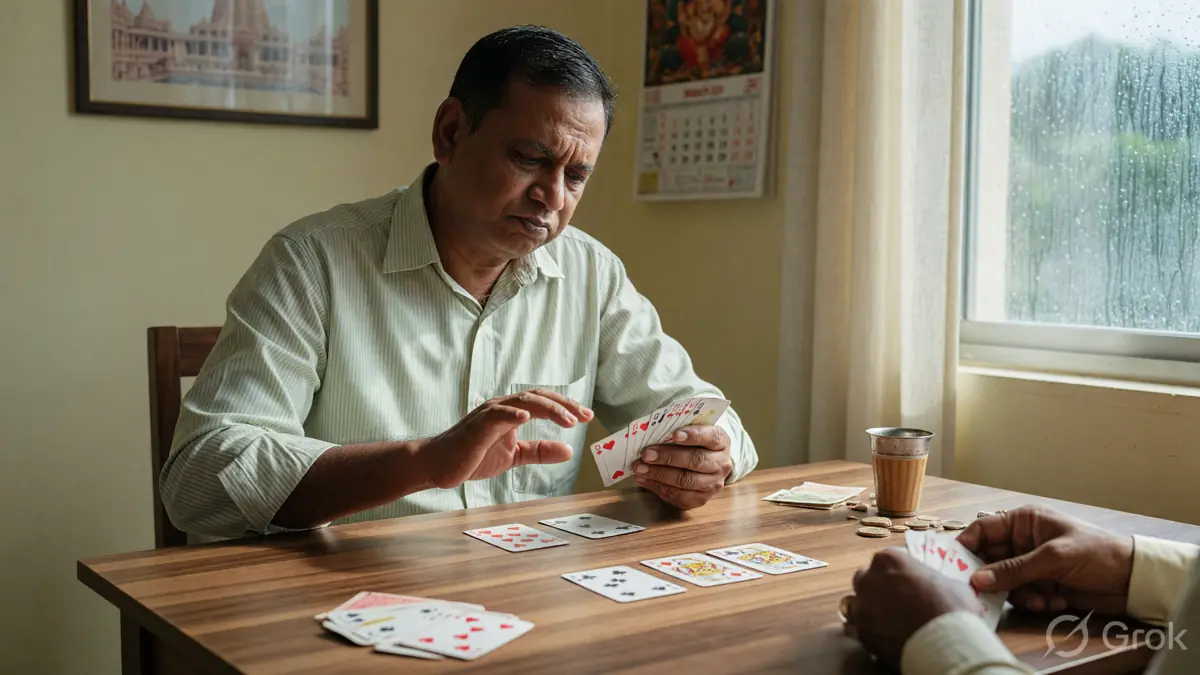
Most “winning rummy” copy assumes the joker will show up in time. Ask the opposite. If the printed joker and the cut joker both stay buried, which groups can you still finish, and which high cards are now only a bill?
That counterfactual is the whole method here. It is not a pep talk. It will not produce a hit rate. It will tell you when a drop is the skilled line rather than a confession.
Holding a joker is a choice with a cost
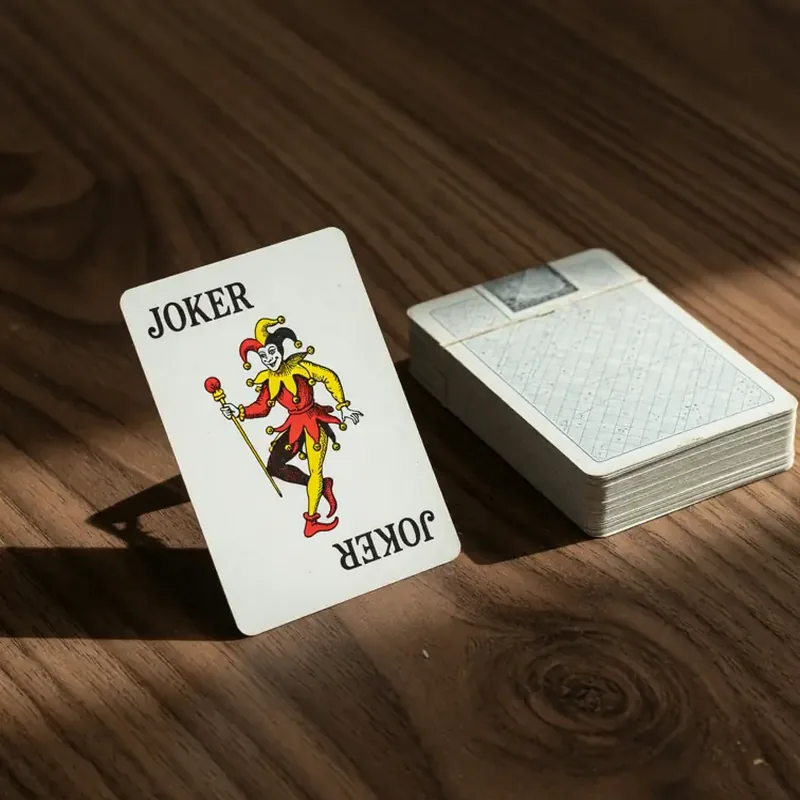
A joker that completes a set or an impure sequence is working. A joker held “for later” is a card that could have been a discard that misleads an opponent, or a slot for a natural card that finishes the pure sequence.
If you already have the pure sequence, a spare joker is more useful. If you do not, the joker is not a rescue. People lose more money protecting a mascot than they lose to a single bad draw.
The discard pile is a record, not a prophecy
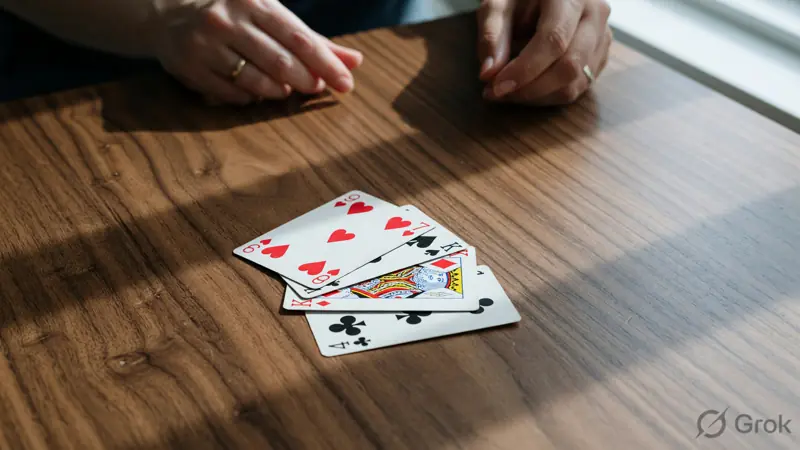
Four face-up discards tell you what left other hands. They do not tell you what remains in the stock. Reading the pile is useful for one thing: avoiding a throw that completes a group you can see someone collecting.
Chasing a card because “nobody has thrown it” is the opposite read. Absence is not possession. The band here is: useful for defence, weak for hunting.
Risk against opportunity, in plain bands
High ungrouped cards are likely expensive if someone else declares. Keeping them because they “might” form a set is an even bet at best and, late in a points hand, unlikely to be worth the price.
A nearly finished pure sequence is likely worth a draw from the stock. A messy hand with two high pairs and no run is unlikely to be saved by one more turn. Middle drop exists for that band.
Pool changes the clock, not the bands. You can survive a bad hand longer. You cannot survive a series of them without noticing the cap. Deals writes the bad hand down and keeps it.
What skill cannot fix
A shuffled stock. A partner who is actually an opponent. A table that hides drop costs. A KYC hold after a “win”. Skill does not reach those objects.
If the object you want to fix is the product, leave this note and use the comparison ledger. If the object is your own session length, use the stop path.
A worked hand, labelled illustrative
Suppose you hold a four-card run that is one card short of a pure sequence, two high unpaired face cards, and no joker. Figures here are for illustration only; verify table rules when you sit.
One more turn hoping for the missing rank is an even-to-unlikely wait. Throwing one high face card is usually cheaper than waiting for both of them to become a set. If the format is points and a middle drop is published, compare that drop to the cost of two face cards if someone else declares now.
If the format is deals, that same wait writes a number you will still see on the last line. The skilled question is not “can I get there”. It is “what does this slip look like if I do not”.
Habits that look like skill and are not
Changing sort order every draw. Taking every open card that “matches a suit”. Holding four jokers’ worth of hope when you have zero jokers. Narrating out loud to intimidate a remote opponent who cannot hear you.
Skill is boring. It looks like a drop, a single sorted group, and a refusal to treat an ad’s win clip as evidence.
Limits, not systems
Is there a system that beats a dead joker?
No. A dead joker changes the groups you can finish. It does not create a hidden extra joker.
Should I always hold the first joker I see?
No. A joker that does not finish a group is still one card not doing work. Holding it “in case” is a habit, not a law.
Does reading the discard pile guarantee a win?
No. It only tells you what someone else did not want. That is a signal, not a result.
When is a middle drop the skilled move?
When the pure sequence is not forming and high cards remain. Skill includes leaving.
Are hit rates published here?
No. Probability language on this note is in bands: likely, even, unlikely. No percentages.
Does luxcasino publish a coach or a house edge?
Not on this desk. Any such figure from an ad is outside the file.
What is the counterfactual this note uses?
The same hand if the joker never arrives.
Where do I go after this?
The reviews ledger, or PLAY NOW if you already accept the limits.
Bankroll is not a strategy, but it bounds one
A session ceiling decided before login is the only number this note will bless. It is not a system. It is a wall. If the product has no deposit control, use the bank or UPI limit you already have.
Crossing the wall because the joker is due is the counterfactual failing in real time. Due is not a card. Due is a story people tell after they have already stayed.
If you cannot name the wall in one sentence, you are not in a strategy problem. You are in a stop-path problem. The responsible-play note is then the correct door.
Reading opponents you cannot see
Remote rummy gives you discards, not faces. Do not invent a personality for a silent seat. The only opponent data you have is what left their hand.
If the same rank is thrown twice, that rank is less likely to be collected. If a suit is never thrown, you still do not know who holds it. Band: weak evidence. Play defence, not a novel.
Points, pool and deals change the cost of being stubborn
In points, stubbornness is priced every hand. In pool, stubbornness is priced when you hit the cap or buy again. In deals, stubbornness is priced on a slip that does not forget.
The skilled adjustment is not a new trick. It is an earlier drop in points, a refusal to re-buy on tilt in pool, and a willingness to dump high cards early in deals so the slip stays small.
If that sounds modest, good. Modest is what survives a dead joker.
What this note will not compute
No combination counts. No promised odds of picking a named rank. Those calculations require a known remaining deck and honest opponents. A remote table gives you neither for free.
If a video promises those numbers, it is entertainment. Close it. Return to the bands: likely, even, unlikely. Then drop or deal.
A last test before you treat a habit as skill
Write down, on paper, the last three times you stayed in a hand you should have dropped. If you cannot remember three, you are not tracking enough to claim a method.
If you can remember three and they all involve waiting for a joker, the method you actually have is hope. Hope is allowed. It is not skill. Name it honestly, then use the drop next time the same shape appears.
That is the end of the test. No certificate. No badge. Just a cheaper next hand.
If you want a number, use a clock
A kitchen timer is a better instrument than a hunch about the next joker. Set it before the first deal. When it rings, stand up. The hand can end without you.
If that instruction feels too simple, you have found the actual limit. Skill ends where the session should end.